For those planning on living in Sausalito, CA, the median sale price for homes is approximately $1,850,000, and available homes are spending roughly 14 days on the market before going under contract. That's a fast-moving environment, and buyers who walk in without context tend to get caught off guard.
Understanding the city's development timeline actually matters here - not as a history lesson, but because the past dictates current zoning, neighborhood layouts, and which structures are protected. Once you see why certain waterfront sectors still carry maritime uses while the hillside districts are lined with early 20th-century construction, the market starts to make more sense.
A Quick Look at Sausalito's Background
The land has been continuously inhabited for a long time. The Coast Miwok people lived in this area for more than 3,000 years before European contact - that's not a footnote, it's most of the story.
Modern settlement started in 1838 when an English seaman named William Richardson received a 19,571-acre Mexican land grant. He built his hacienda near what is now Caledonia Street, and that decision established the foundation for the current street grid. The community grew steadily from there, and on September 4, 1893, the city was officially incorporated - creating the municipal structure that still governs the area today.
City Status and Government
Sausalito operates as an incorporated city with its own municipal government, managing local services, zoning codes, and preservation guidelines independently of neighboring towns.
At the federal census level, the city belongs to the San Francisco-Oakland-Fremont, CA Metropolitan Statistical Area. That designation has real consequences - it shapes regional transit planning and where infrastructure funding flows.
Location and County Boundaries
Sausalito sits entirely within Marin County, California, at the county's southern tip, directly across the Golden Gate Strait from San Francisco. If you buy here, you're paying Marin County property taxes, and all assessments and public records run through the county offices in San Rafael.
The city limits don't cross into any neighboring jurisdictions, which keeps the tax calculations and administrative side of a transaction cleaner than you might expect for a city this close to San Francisco.
Regional Commuting Ties
Being inside the San Francisco-Oakland-Fremont, CA Metropolitan Statistical Area means regional traffic patterns are part of daily life. Commuters depend on Marin County transit networks and the Golden Gate Bridge to reach employment centers, and the local housing market moves in step with the broader regional economy.
Buyers comparing options often find themselves looking across Marin County inventory when they're pricing out homes in the $1,850,000 range.
The Origins of the City's Name
The name traces directly to William Richardson's 1838 Mexican land grant. That 19,571-acre tract was officially titled Rancho Sausalito - Spanish and Mexican land grants typically used landscape features to mark their boundaries, and that title stuck to the settlement that grew up around Richardson's hacienda.
Naming Consistency
When residents voted to incorporate on September 4, 1893, they kept the Rancho Sausalito namesake, and the spelling hasn't changed since. You'll see it on all official property deeds and title documents, and it applies today to the incorporated city limits, the local school district boundaries, and the postal codes.
Historic Landmarks and Local Museums
The city takes preservation seriously, and you'll feel that the moment you start pulling permits. A useful reference point is The Sausalito Woman's Club - a Craftsman-style clubhouse built in 1918, designed by pioneering architect Julia Morgan. The city named it Sausalito Historic Landmark #1 in 1976, and it was listed on the National Register of Historic Places in 1993. That sequence of designations is a good illustration of how local and federal protections can stack up on a single property.
If you want to dig deeper into the local architecture, the Ice House Museum at 780 Bridgeway is worth your time. The Sausalito Historical Society runs it as an interactive multimedia museum documenting the area's land, water, and people.
Archives and Exhibits
Inside the Ice House Museum, the Phil Frank History Research Room gives the public access to municipal archives. Property owners use it regularly to trace the origins of their own homes - it's more useful than most buyers realize before they're in contract.
The Historical Society also maintains the Historic WWII Marinship Exhibit at the Bay Model, which covers the waterfront's industrial expansion during the 1940s in considerable detail.
Defining Industries and Notable Residents
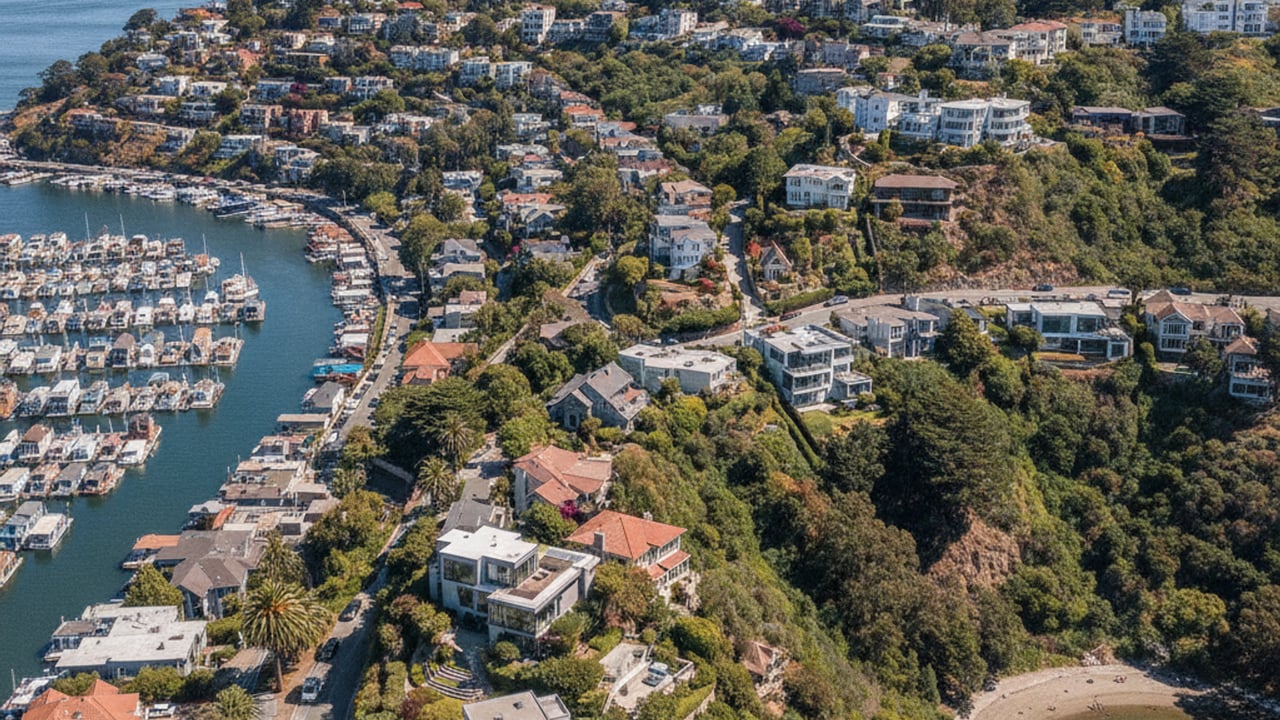
The city's identity is deeply tied to its maritime past. During World War II, the Marinship shipyard manufactured Liberty ships for the military - a full-scale industrial operation that left a permanent mark on the waterfront. That same stretch of shoreline is now home to an iconic floating home community of houseboats at Waldo Point Harbor.
Alongside the shipbuilding history, Sausalito developed a waterfront dining scene and an active art colony. That mid-20th-century bohemian environment pulled in a specific mix of artists, writers, and musicians, and it shaped how the city thinks about itself today.
Famous Figures Connected to the Area
The local historical record includes actor Sterling Hayden, philosopher Alan Watts, author Shel Silverstein, and singer Otis Redding. Artist Jean Varda, bassist John Kahn, and baseball pitcher Tim Lincecum also spent time here. And then there's Sally Stanford - a former brothel owner who later became the city's mayor, which tells you something about Sausalito's particular relationship with its own past.
Frequently Asked Questions
Are there special restrictions for renovating historic homes in Sausalito, CA?
Yes. Properties with formal historic designations must follow specific municipal preservation guidelines. You should consult the city's planning department before altering the exterior of any older home.
Can buyers of historic Sausalito properties qualify for property tax breaks under the Mills Act?
It depends on the property's official status. Owners of designated buildings - such as those listed on the National Register of Historic Places - can sometimes secure Mills Act contracts that reduce property taxes in exchange for preservation work.
Which neighborhoods in Sausalito, CA have the highest concentration of original, historic homes?
The area around Caledonia Street features some of the oldest residential plots, dating back to the location of William Richardson's 1838 hacienda. Buyers will also find early 1900s Craftsman architecture preserved in the older hillside districts.
What happens if a property I want to buy in Sausalito is designated as a local historical landmark?
If a property holds a status similar to Sausalito Historic Landmark #1, the city will require additional reviews for any structural changes. You must submit renovation plans to the local planning commission to ensure the work matches the original architecture.
Does a documented historical background increase a property's resale value in the Sausalito real estate market?
It often does. With local homes selling for approximately $1,850,000 in just 14 days, buyers frequently pay a premium for verified historical architecture or properties tied to the mid-century art colony.
How did Sausalito's WWII Marinship history shape the current residential zoning of the waterfront neighborhoods?
The WWII-era Marinship shipyard left a permanent industrial footprint along the shoreline. Today, that infrastructure supports mixed-use maritime zoning and the floating home community at Waldo Point Harbor.