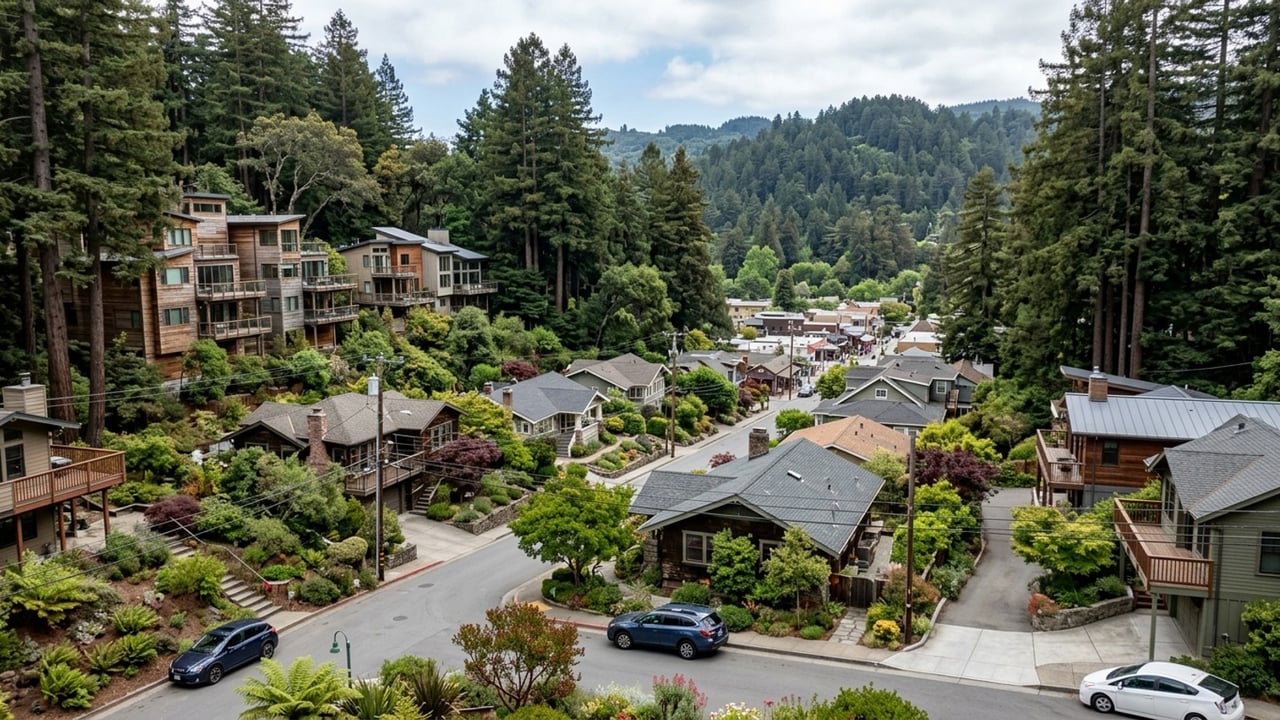
Marin County doesn't offer a single kind of buyer experience - and the choice between living in Mill Valley and Ross is a good example of that. Both towns sit just north of the Golden Gate Bridge, both give you immediate access to outdoor recreation and a reasonable shot at San Francisco, and both will test your budget in ways that feel almost personal. But they operate as distinct markets, and confusing them is an easy mistake to make early in a search.
Mill Valley has the larger population, a genuine downtown, and a mix of housing styles that includes condominiums. Ross is something else entirely - a small, secluded enclave built around large estates and an unusually firm commitment to land-use conservation. High property values, limited inventory, and strict local zoning rules apply to both. The way those factors play out, though, is very different depending on which town you're focused on.
Real Estate Markets and Home Prices
Property taxes in both towns fall under California's Proposition 13 base rate - roughly 1% of assessed value, plus any local voter-approved bonds. Because both markets command premium prices, those local assessments add up fast when you're calculating monthly carrying costs. Inventory moves quickly in this part of Marin County, especially near the median price point.
Recent 2026 market data puts the median sale price in Mill Valley at approximately $3.23 million. Homes there spend roughly 9 days on the market before going under contract, and the average property sells for about 114% of its list price. That last number tells you everything you need to know about what you're walking into.
Pricing and Market Trends
Ross is consistently one of the most expensive towns in Marin County. Median sale prices there range from $3.3 million to $4.8 million depending on the quarter and which brokerage data you're looking at. Zillow places the typical home value in Ross at roughly $3.88 million for 2026.
The math gets complicated fast in Ross because there are so few homes for sale at any given time. One high-end transaction can skew the monthly median significantly. Mill Valley had 21 homes on the market in a recent late-spring 2026 snapshot - a slightly larger pool, which at least gives buyers something to tour.
Property Types and Architecture
Mill Valley's housing stock is mostly single-family homes built into hillsides and redwood canyons, with condominiums and townhomes concentrated near the downtown area. That variety creates somewhat different price entry points depending on which neighborhood you're targeting.
Ross real estate is almost entirely large single-family homes and estates. Properties on prominent streets like Shady Lane or Lagunitas Road frequently trade between $7 million and $15 million. Condominiums and multi-family units are practically non-existent there - a direct result of the town's small size and strict land-use conservation rules. If you're hoping to find an attached unit in Ross, stop looking.
Location, Commute, and Transit Options
Both towns sit near U.S. Highway 101, which is the primary artery for anyone driving south into San Francisco or north toward wine country. Commuters in both areas use a mix of personal vehicles, ferries, and regional buses. General commuting data for Ross shows 53.1% of working residents drive to work, while only 0.6% rely on public transit.
Access to the Golden Gate Ferry is a real draw in this part of Marin. Residents of both towns can drive to terminals in nearby Sausalito or Larkspur for a direct trip across the bay. Which town you choose will largely determine which bus routes and local roads become part of your daily routine.
Transportation in Mill Valley
Mill Valley drivers use U.S. Highway 101 and State Route 1, which includes Shoreline Highway and Panoramic Highway. Golden Gate Transit runs several bus routes through the area, including the dedicated Route 114 from Mill Valley to San Francisco via the Golden Gate Bridge. Connecting routes 130 and 132 offer additional local transit options.
Commuting from Ross
Ross sits along Sir Francis Drake Boulevard, which gives residents a straight path to U.S. Highway 101. The town connects to the Golden Gate Transit bus network via Route 25, linking Ross with Fairfax, San Anselmo, College of Marin, Kentfield, and Greenbrae. The SMART train's Marin stations along the 101 corridor are also a short drive away.
Parks and Local Amenities
Open space isn't an amenity in these towns - it's the whole point. Local geography limits commercial expansion, which keeps retail concentrated and the natural landscape intact. People don't move to this part of Marin County despite the lack of strip malls; they move here because of it.
Mount Tamalpais State Park borders Mill Valley, putting over 60 miles of hiking trails essentially at residents' doorsteps. The Old Railroad Grade Trail runs from the Mountain Home Inn down to Blithedale Ridge. That kind of access is a permanent fixture here, not a selling point that changes with market conditions.
Mill Valley Outdoor Spaces
Old Mill Park is a redwood-shaded anchor near Mill Valley's downtown commercial center. It has picnic areas, a historic amphitheater, and a playground - and it serves as the starting point for the Dipsea Steps and the Dipsea Trail. If you're a runner or a hiker, you probably already know what that means.
The Ross Enclave
Ross is a forested town surrounded by Marin County open space, and the town prioritizes that quiet, secluded character over commercial development. Nature access is immediate. What Ross doesn't offer is the kind of downtown retail scene you'd find in Mill Valley - and that's entirely by design.
Choosing Between Mill Valley and Ross
The choice usually comes down to budget and what kind of home you're actually looking for. Mill Valley has a faster-moving market - roughly 1.2 months of supply, a higher volume of transactions, and intense buyer competition. Ross requires a higher baseline budget and considerably more patience, since far fewer homes hit the market each year.
Getting your budget aligned with local market medians before you start touring properties will save you real frustration. A $3.5 million budget puts you slightly above the median sale price in Mill Valley. In Ross, that same $3.5 million gets you into the entry-level tier for single-family homes - and entry-level there is a relative term.
Budget and Inventory Factors
Mill Valley's $3.23 million median comes with serious competition - 94% of homes sell above list price, which means multiple-offer situations aren't the exception, they're the expectation. In Ross, the problem isn't competition so much as scarcity. You may wait months for anything to list on a specific street like Lagunitas Road, and when it does, it won't stay available long.
Matching Your Preferred Home Style
Condominiums and townhomes exist in Mill Valley. They don't exist in Ross. That's not a nuance - it's a firm boundary set by the town's zoning. Buyers who want an expansive private estate with strict local conservation rules around it will find Ross is the right fit. Everyone else should be looking at Mill Valley.
Frequently Asked Questions
Is it generally more expensive to buy a home in Ross or Mill Valley, CA?
Yes, Ross is generally more expensive. The median sale price in Ross ranges from $3.3 million to $4.8 million, while Mill Valley's median sale price is approximately $3.23 million.
Which town offers a faster daily commute to San Francisco: Mill Valley or Ross?
Mill Valley is located further south along U.S. Highway 101, which places it closer to the Golden Gate Bridge. Both towns offer access to the Golden Gate Ferry and regional transit routes for commuting into the city.
How does the downtown lifestyle and walkability in Mill Valley compare to Ross?
Mill Valley features a downtown area with retail, condominiums, townhomes, and access to Old Mill Park. Ross operates as a secluded, forested enclave with large estates and minimal commercial development.
Are building, zoning, and remodeling restrictions stricter for homeowners in Ross compared to Mill Valley?
Ross enforces strict land-use conservation rules that heavily restrict the development of condominiums and multi-family units. Mill Valley offers a wider mix of property types, including downtown townhomes and attached housing.