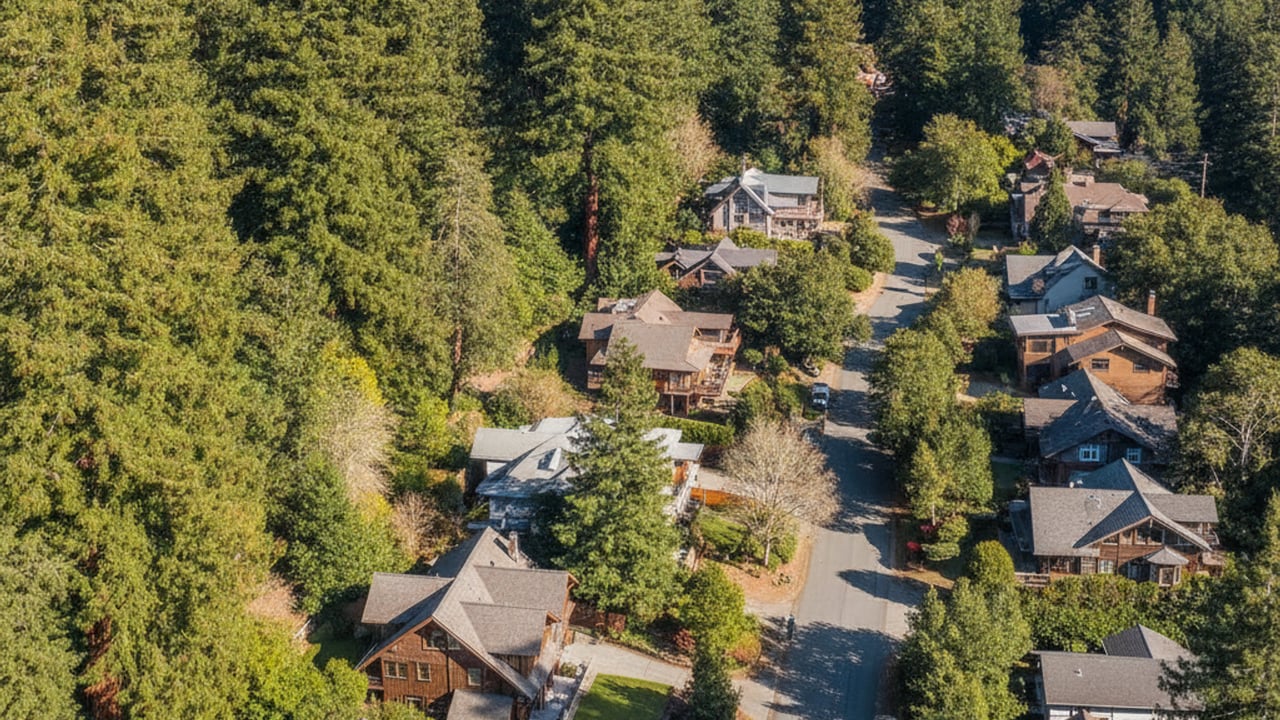
Mill Valley, CA sits just 14 miles north of San Francisco via the Golden Gate Bridge. That geography isn't incidental - the timber industry and early California settlement shaped the street layout, drove decisions about what to preserve, and explain why so much of the surrounding redwood forest is still standing. Today, living in Mill Valley means being surrounded by that history.
The real estate market reflects all of that. As of mid-2026, the median sale price for homes in Mill Valley is around $3.22 million. Inventory runs tight at about 21 available homes, properties are spending roughly 9 days on the market, and they're selling for almost 114% of list price. You read that right.
A Quick Look at Mill Valley's Background
The earliest recorded Anglo-Saxon settler in Marin County was John Thomas Reed, an Irishman born in Dublin in 1805. He arrived in 1826 and received the first Mexican land grant north of the bay - Rancho Corte Madera del Presidio. To process wood from the surrounding wilderness, he built the first saw mill in Marin County in approximately 1835, a structure that ran on a mortise and tenon joint system secured by oak pegs and an undershot wheel.
That mill is the seed from which everything else grew.
Basic Facts About the City
The Tamalpais Land & Water Co. eventually sold off shares of the land, which led to formal incorporation of the Town of Mill Valley. The official state charter came on September 1, 1890. Ten years later - September 1, 1900 - the municipality incorporated as the City of Mill Valley, and in 1947 the town officially transitioned its title to reflect that standing.
City, Town, or Neighborhood?
Buyers coming from out of state ask this one constantly. Mill Valley is a distinct, incorporated city - not a neighborhood tucked inside a larger municipality. It runs its own local government and services. The city limits cover the immediate valley, though some surrounding unincorporated areas share the same zip codes and mailing addresses, which is where the confusion usually starts.
Mill Valley's Location and County Details
Mill Valley sits entirely within Marin County, California - no county line crossings, no ambiguity. Regionally, it belongs to the San Francisco Bay Area and falls within the broader San Francisco-Oakland-Berkeley metropolitan area. Commuters rely on that positioning for access to major employment centers across the bridge.
County Lines and Metro Connections
The city's spot in southern Marin County places it close to Muir Woods National Monument, which contains some of the most recognized redwood forests in Northern California. That combination - San Francisco a bridge-length away, vast protected wilderness on the other side - drives consistent housing demand. The limited space between the bay and the parklands keeps new construction scarce, and scarce construction keeps inventory low. The numbers above make a lot more sense once you understand the geography.
The Meaning and Origin of the Name Mill Valley
The name is exactly what it sounds like: it comes directly from John Thomas Reed's original 1835 saw mill, one of the first built in Northern California. During the initial land auction, the mill functioned as an unofficial town square for early residents. When it came time to put a name on the place, the founders went with the structure that had held the community together.
The Story Behind John Thomas Reed's Mill
Several alternative names were proposed before founders settled on Mill Valley. The original mill site is now preserved at Old Mill Park, and the structure itself is a Registered California Historical Landmark. It's not a roped-off curiosity - it's still a genuine community fixture, a physical reminder of where the timber processing began.
Founding Timeline and Early Settlement
The timeline starts with Reed's arrival in 1826 and the mill construction in 1835. For decades after that, the area stayed a rugged outpost built around timber and Rancho Corte Madera del Presidio. By 1873, other settlers like Dr. John Cushing were establishing themselves in places like Blithedale Canyon. Population growth was slow and deliberate until the formal land auctions of the late 19th century picked up the pace.
Incorporation and Growth
The September 1, 1890 charter marked the official beginning of the Town of Mill Valley. The September 1, 1900 incorporation solidified its status as a permanent municipality. Over the decades that followed, the city moved away from its logging and railroad identity and became the residential enclave it is today. The 1947 shift to the official title of City of Mill Valley was the administrative acknowledgment of what the place had already become.
Historic Landmarks and Local Museums
Old Mill Park anchors the historic landscape - the original 1835 saw mill is the most prominent site in the city. The Cushing Amphitheatre, named for Dr. John Cushing, is another notable location. Up on Mt. Tamalpais, the Gravity Car Barn Museum at East Peak preserves the history of the historic gravity railway, once known as the "Crookedest Railroad in the World." And in town, the Sequoia Cinema has been around since 1929, when it opened as a 1,200-seat single-screen venue.
Preserving the Past at the Public Library
The Mill Valley Historical Society formed in January 1978 through the efforts of local citizens. They oversee the installation of historic plaques and signage throughout the city and collaborate with the Mill Valley Public Library to support the Lucretia Hanson Little History Room - a space that houses photographs, records, and artifacts documenting the city's development. If you're researching a property's background, that room is where you start.
What Mill Valley is Known For Today
Beyond its proximity to San Francisco and Muir Woods National Monument, Mill Valley hosts the annual Dipsea Race - the second-oldest footrace in the United States. The cultural pull runs deep too. The Mill Valley Film Festival began in 1978 and has operated for over forty-two years, drawing international filmmakers to the area year after year.
Famous Residents and Local Legends
The natural surroundings have pulled in artists, musicians, and public figures for generations. Janis Joplin and Jerry Garcia both lived here and drew inspiration from the environment. Jack Kerouac, Bonnie Raitt, Tom Cruise, Nicole Kidman, Huey Lewis, Mariel Hemingway, and author John Gray have all called Mill Valley home. The city was also home to Jenny Fulle, the first girl in the United States allowed to play Little League baseball. That particular detail tends to surprise people.
Frequently Asked Questions About Mill Valley Real Estate
Does my older Mill Valley home qualify for the Mills Act for property tax reductions?
It depends. A property must be formally designated as a historic landmark or contribute to a historic district to qualify for Mills Act consideration.
What is the process for getting a house designated as a historic property in Mill Valley, CA?
Owners need to coordinate with local municipal planning departments to verify the property's significance. The Lucretia Little History Room at the public library maintains photographs and records that can help establish a home's background.
What happens if I buy a historic home in Mill Valley and want to tear it down or do a major remodel?
Expect mandatory municipal review. Homes with historical status or those near established landmarks like Old Mill Park require specialized permits to alter the exterior or demolish the structure. This is not a fast process.
Which neighborhoods in Mill Valley have the highest concentration of original historic homes?
The areas surrounding Old Mill Park and Blithedale Canyon contain many of the city's older properties. Dr. John Cushing settled in Blithedale Canyon as early as 1873, and early residential development spread outward from those central points.
What are the most common historical architectural styles buyers will find in Mill Valley?
Many of the earliest homes reflect the city's origins in the timber industry. You'll find older properties built primarily from local wood - a direct legacy of the saw mills that processed timber from the surrounding redwood forests.
How did the Mount Tamalpais Scenic Railway shape Mill Valley's original real estate development?
The railway brought visitors and early residents up the mountain, spurring development along its route. The Gravity Car Barn Museum at East Peak still preserves the history of that transit system, which operated as a historic gravity railway.